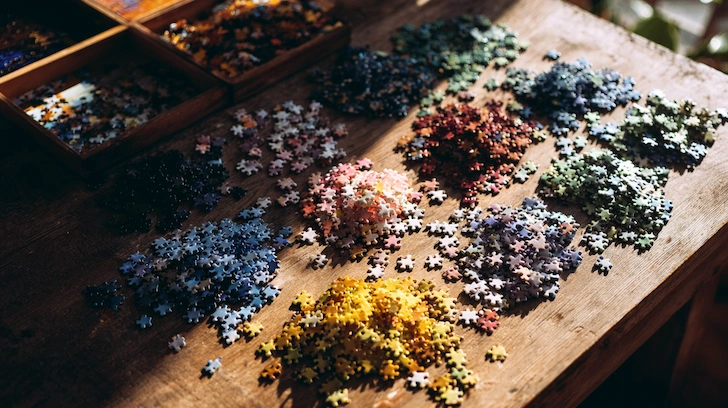
How to Sort Puzzle Pieces: Expert Strategies for Faster Assembly
The Chaos-to-Order Blueprint
The most effective sorting methodology relies on a "two-phase" process: a rough sort to establish boundaries and major zones, followed by a refined sort for specific textures and shapes. This approach turns a mountain of cardboard into a manageable engineering project.
Before you touch a single piece, you need to understand the broader strategy of assembly. This strategic pause is often the difference between frustration and flow, and it is central to the best way to solve a jigsaw puzzle.
The "Face-Up" Rule You cannot solve what you cannot see. Your absolute first step is flipping every single piece face up to assess the landscape. This simple action is the foundation of all subsequent organization.
Containment Strategy Utilizing sorting trays allows you to categorize pieces without cluttering your primary workspace. Common sets of 8 trays can effectively manage puzzles up to 1500 pieces, keeping your table clear for the actual assembly.
The Cognitive Economics of Sorting
Sorting is an efficiency hack that reduces cognitive load by breaking a massive, overwhelming image into manageable micro-tasks. It transforms the anxiety of "where do I start?" into a series of small, achievable wins.
Without a strategy, the sheer volume of visual data leads to "puzzle burnout." Sorting filters this noise, allowing your brain to focus on specific colors or patterns without getting overwhelmed by the whole.
Proper organization significantly reduces the total project duration. This efficiency is how expert solvers consistently beat the average time for a 1000 piece puzzle.
Burnout Prevention By compartmentalizing the puzzle, you create opportunities to switch gears. If you get stuck on a blue sky, you can simply switch trays to sort red flowers, keeping your momentum alive without frustration.
The Hardware of Organization
While household items can suffice for casual solving, dedicated tools like stackable trays are essential for managing the logistics of high-difficulty projects. The right hardware protects your progress and your sanity.
DIY solutions like muffin tins, baking sheets, and Tupperware work well for smaller puzzles. However, specialized tools become necessary when you tackle challenging jigsaw puzzles with higher piece counts.
- Stackable/Hexagonal Trays: These designs save critical table space and allow you to "put away" sections easily.
- Capacity: Look for sets designed to accommodate up to 1500 pieces to ensure you have enough room for larger projects.
- Lidded Options: Lids are essential for the "cat defense" strategy, protecting your hard work from pets and dust.
Box Tops Don't forget the box itself. Use the box bottom and top to hold the largest, most distinct groups of pieces, such as the sky or a dominant background color.
The S.O.R.T. Method
The S.O.R.T. Method (Study, Orient, Rough-group, Texture-refine) provides a structured framework to transform a chaotic pile into an organized engineering project. Following this sequence ensures you never feel lost.
- STUDY the Reference: Analyze the box image to identify "Anchor Points" like text, faces, or buildings. Do not start sorting until you understand the image composition and border layout.
- ORIENT the Pieces: Dump all pieces onto the table and systematically flip every single one face up. This is the most tedious step, but it is critical for visibility.
- ROUGH-GROUP the Boundaries: The initial mechanical step of assembly almost always begins with the frame, which is widely considered the best way to start a jigsaw puzzle. Isolate all edge pieces to build the frame while simultaneously separating pieces into broad color categories like "All Blue" or "All Green."
- TEXTURE and Shape Refinement: Once the frame is built and colors are separated, refine your sort within the trays. Group pieces by texture (foliage vs. fabric) or specific shape characteristics like tabs and knobs.
Advanced Filtering Tactics
When basic color sorting fails, you must rely on nuanced filtering tactics like gradient analysis, shape morphology, and object isolation to solve complex sections. These techniques are your lifeline for the most difficult parts of the image.
- The Gradient Approach: For puzzles with slow color transitions like skies or water, sort by shade intensity rather than just hue. Arrange pieces in your tray from light to dark to visualize the transition.
- Shape Morphology: When color is useless, such as in a solid black section, sort exclusively by the physical shape of the tabs and blanks. Group "two-tab," "three-tab," and "four-tab" pieces into separate piles.
- Object Isolation: Identify and isolate specific distinct elements into their own dedicated small trays or muffin tin cups. This works best for high-contrast items like "roof tops," "shirts," or "text."
Preservation and Environment
Maintaining a clean, well-lit environment and a disciplined sorting system ensures your puzzle remains a source of joy rather than a clutter hazard. Your physical space directly impacts your mental clarity.
- Lighting: Adequate lighting is non-negotiable. You cannot sort subtle shade differences or textures effectively in dim light.
- Tray Hygiene: Clean your sorting trays regularly. Dust buildup can affect how pieces sit and potentially damage the fit of your puzzle.
- Eco-Factor: Choose reusable wooden or plastic sorting trays. They are a superior, eco-friendly alternative to using disposable plastic sandwich bags for storage.
By maintaining a disciplined sorting system, you transform a chaotic pile of cardboard into a streamlined engineering project. This organization allows you to focus on the joy of the "click" rather than the frustration of the search.
Frequently Asked Questions
What is the S.O.R.T. method for jigsaw puzzles?
The S.O.R.T. method stands for Study, Orient, Rough-group, and Texture-refine. It is a structured framework that begins with analyzing the box image and flipping pieces face-up, followed by separating edges and broad color groups, and finally refining those groups by texture or shape.
How do you sort a 1000-piece puzzle efficiently?
Start by flipping every piece face-up and using the box tops to hold large, distinct groups like the sky, while distributing smaller categories into stackable trays. Isolate the edge pieces to build the frame first, then separate the remaining pieces into broad color groups before refining by pattern or object.
What are the best types of puzzle sorting trays?
The most effective trays feature stackable, hexagonal designs to save table space and include lids to protect your progress from pets and dust. Look for sets designed to accommodate up to 1500 pieces to ensure you have sufficient capacity for larger projects.
How do you solve single-color sections where color sorting fails?
When color offers no clues, such as in solid black sections, use 'Shape Morphology' to sort pieces exclusively by the physical shape of their tabs and blanks. Grouping pieces into piles of 'two-tab,' 'three-tab,' and 'four-tab' shapes allows you to solve based on mechanical fit rather than visual design.
Are there sorting tools suitable for travel?
Yes, magnetic sorting trays are ideal for travel as they hold pieces securely in place to prevent sliding during movement. Additionally, compact stackable trays with tight-fitting lids are excellent for keeping sorted sections intact while in transit.
How can I organize trays for faster piece retrieval?
Labeling your sorting compartments allows you to quickly distinguish between similar groups, such as specific gradients or textures. This simple step prevents confusion and speeds up the assembly process by ensuring you grab the right tray for the section you are working on.
How should I handle puzzles with irregular piece sizes?
For puzzles featuring non-standard cuts, add a sorting step that categorizes pieces by physical size alongside color and pattern. Grouping significantly larger or smaller pieces together often reveals their likely position within the puzzle's unique grid or border.
How can groups collaborate effectively when sorting a puzzle?
Assign specific sorting roles to each person, such as one person focusing on edge pieces while others tackle specific colors or distinct objects like faces and text. This division of labor prevents overcrowding the workspace and ensures all sorting categories are processed simultaneously.