Jigsaw Puzzle Tips for Beginners: Essential Strategies to Solve Like an Expert
The Puzzler's Launchpad
To successfully launch your first puzzling experience, you must match your skill level to the challenge and secure a well-lit environment. For an adult beginner, the ideal starting point is a 300-piece puzzle, while children should begin with fewer than 100 pieces to ensure a sense of accomplishment rather than frustration.
Starting with the right piece count is the single most effective way to guarantee a positive experience. A 300-piece puzzle offers enough complexity to be engaging without becoming an endurance test. It allows you to learn the mechanics of assembly without the overwhelming volume of a larger project.
Once you have your puzzle, you must control your environment. Success relies heavily on lighting; you need adequate illumination to distinguish subtle color variations before you even open the box. Dim lighting will hide the nuances you need to see, turning a relaxing activity into a strain on your eyes and patience.
Mastering the fundamental strategies of assembly is crucial for reducing frustration and building confidence. As you prepare to begin, you should familiarize yourself with essential puzzle techniques that will serve as your roadmap for the process ahead.
Defining the Mission: Selection and Workspace Setup
Your mission begins with selecting a high-contrast image and establishing a dedicated workspace that fits the finished dimensions of your puzzle. You should avoid large fields of solid color and instead choose a location where your project can remain undisturbed for the duration of the build.
Selection Strategy When choosing your puzzle, look for high color variation and distinct objects. Avoid images with vast expanses of blue sky or dark shadows, as these are notoriously difficult for novices. Finding the right entry-level product is the first step to enjoyment, so take time to browse for beginner-friendly puzzles that catch your eye and offer clear, distinct visual zones.
Workspace Essentials
- Workspace Logic: Before claiming the dining room table, check the finished dimensions listed on the box. Select a low-traffic area where the puzzle can sit safely without being bumped or moved.
- Portability Tactics: If you cannot dedicate a table solely to this project, use a puzzle board, mat, or jigsaw roll. These tools allow you to store your progress and move the puzzle out of the way when life intervenes.
- Lighting Setup: Position a wireless desk lamp nearby to avoid cord interference, or wear a headlamp to eliminate shadows entirely. Clear visibility is your best tool for identifying matching pieces.
The 4-Step Assembly Protocol
The most efficient way to assemble a puzzle is to follow a linear four-step process: filter and flip the pieces, build the perimeter frame, assemble distinct interior sections, and finally integrate those sections into the whole. This framework transforms a chaotic pile of cardboard into a manageable, step-by-step engineering task.
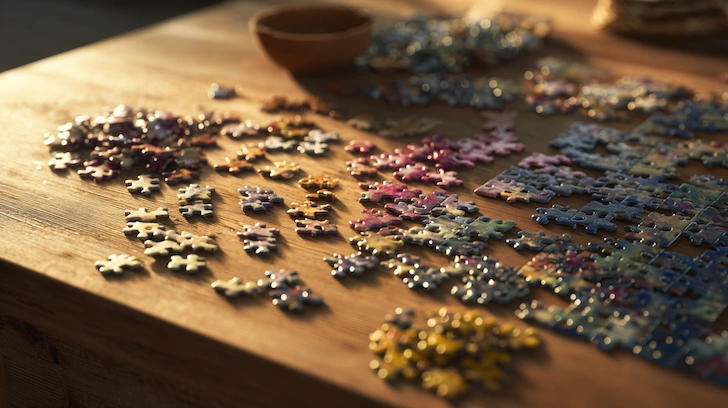
- The Filter & Flip: Lift pieces out of the box by hand rather than dumping them; this leaves the puzzle dust behind. Immediately flip every piece picture-side up. Effective categorization is the backbone of puzzle solving, so you may want to review how to organize puzzle pieces to keep your workspace tidy.
- The Perimeter: Sort out the edge pieces, which are easily identified by their flat sides. Assemble this border frame first. This creates a defined workspace and gives you a concrete boundary for the rest of the image.
- The Interior Sections: Do not try to fill the middle randomly. Instead, identify distinct colors, patterns, or wording. Assemble these "islands" separately using the box image as a reference guide.
- The Integration: Once you have built several interior islands, place them in their approximate final locations within the frame. Use a puzzle scoop or a simple spatula to move these delicate sections safely without breaking them.
Troubleshooting and Momentum Management
When you hit a wall or face fatigue, you must shift tactics by sorting pieces by physical shape rather than color and changing your physical perspective. If frustration sets in, the most effective move is often to step away and reset your mental focus.
- Tactical Shift: When dealing with solid color sections where visual cues fail, stop looking at the image. Sort the remaining pieces by shape (counting knobs and holes) and test fits based on physical geometry.
- Perspective Change: If you are stuck, change your physical perspective. Walk around the table to view the pieces from a different angle; a new vantage point often reveals connections you missed.
- Quality Control: Constantly check for raised edges or gaps. If a piece requires force to fit, it is likely misplaced. A correct fit should be smooth and flush.
Understanding time investment helps manage expectations as you progress to larger challenges. While your current project is manageable, you might eventually wonder how long it takes to do a 1000 piece puzzle as you look toward future projects.
If frustration persists, switch to a different section or take a break entirely. Puzzling is a marathon, not a sprint. Set a relaxing atmosphere with music to maintain focus, and remember that stepping away is a valid strategy to regain your momentum.
The Final Outcome: Preservation or Reset
Upon completion, you have two distinct paths: permanently archiving your work for display or disassembling it to reset the challenge. Both options validate your effort, whether through a physical trophy or the satisfaction of a completed cycle.
- Option A: Archival: If you plan to frame your work, you will need to glue it. Place a piece of cardboard cut 2 inches larger than the puzzle underneath it before applying glue to protect your table and ensure full coverage.
- Option B: The Reset: If you do not wish to display it, disassemble the puzzle. You can box it up to replay later or pass it on to another beginner, extending the lifecycle of the game.
Frequently Asked Questions
How many pieces should a beginner puzzle have?
Adult beginners should start with a 300-piece puzzle to ensure the challenge is engaging but not overwhelming. For children, it is best to select a puzzle with fewer than 100 pieces to foster a sense of accomplishment rather than frustration.
What is the correct order for assembling a jigsaw puzzle?
The most efficient protocol is to first flip all pieces picture-side up, then assemble the border frame to define the workspace. Once the perimeter is complete, build distinct interior sections based on color or pattern before integrating them into the final image.
What are common mistakes to avoid when building a puzzle?
Common mistakes include choosing images with large areas of solid color or working in dim lighting, which hides necessary visual cues. Additionally, avoid forcing pieces together; a correct fit should be smooth and flush without requiring pressure.
What puzzle shapes are best for beginners?
Beginners should select puzzles featuring standard shapes, like squares or rectangles, rather than complex or irregular cuts. Standard geometry makes it easier to identify edge pieces and visualize connections, reducing the difficulty of the initial learning curve.
What is the best surface for puzzle assembly?
A vinyl surface is highly recommended because it allows pieces to slide easily without catching, though a puzzle board or mat is excellent for portability. Whichever surface you choose, ensure it is located in a low-traffic area and is large enough to accommodate the puzzle's finished dimensions.
How can I organize puzzle pieces without professional trays?
If you lack professional sorting trays, you can use household items like paper plates or baking sheets to separate pieces by color and texture. This method keeps your workspace organized and prevents pieces from being lost or mixed up during the assembly process.