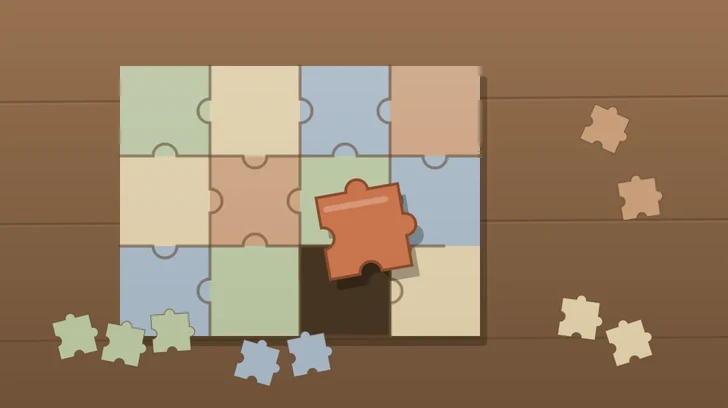
Are Puzzles Good for Your Brain? What the Evidence Actually Says
Here is the honest short answer: jigsaw puzzles give your brain a real workout in a specific set of skills — visual search, mental rotation, spatial working memory — and with practice you get measurably better at those skills. What the research does not show is that this improvement spreads out and makes you generally smarter, protects you from dementia, or raises some overall brain score. Almost every article on this topic tells you the flattering half and skips the rest. I solve puzzles nearly every day and have for most of my life, so I have no interest in talking you out of the hobby. But if you're asking whether it's a productive use of your time, you deserve the actual evidence, not a warm bath of recycled claims.
So this article does something slightly unusual for a puzzle site: it reads the studies. What your mind is really doing over a half-finished 1000-piece puzzle, what the one randomized trial on jigsaw puzzling found, what a decade of brain-training research says about "transfer," where the dementia headlines come from and why they overreach — and then the case for puzzling that survives all of that scrutiny, which I'd argue is the only case worth making.
What "good for your brain" would need to mean
Before any studies, one distinction does most of the work in this whole debate. When you practice an activity, you reliably improve at that activity and things very close to it — researchers call this near transfer. The interesting question is far transfer: does getting better at puzzles make you better at things that aren't puzzles — remembering names, reasoning through problems, staying sharp at eighty? Near transfer is one of the most dependable findings in psychology. Far transfer is one of the most stubbornly elusive.
Every "puzzles boost your brain" headline quietly assumes far transfer. That's the claim to test. Nobody needs a study to confirm that a person who puzzles weekly gets faster at puzzling; you can watch that happen in your own living room over a month. Whether those hours are also buying you general cognitive improvement is a different claim, and the evidence for it is much thinner than the headlines suggest.
The mental work inside a jigsaw puzzle
None of that skepticism means the work isn't real. Sit over a puzzle and pay attention to what you're actually doing, because it's a denser stack of cognitive operations than almost anyone gives it credit for.
Start with visual search. You hold a fragment of the picture in mind — a slice of rust-red roof tile, a particular curl of cloud — and sweep hundreds of candidates for it, ignoring near-misses, while the target may be rotated, dimmer than you remember, or mostly the wrong color with a sliver of the right one. Then there's mental rotation: judging whether a piece fits doesn't require physically trying it, because you can turn it in your head first. That ability is one of the most carefully measured operations in cognitive psychology. In a classic 1971 experiment in Science, Roger Shepard and Jacqueline Metzler showed that the time people need to judge whether two shapes are the same object grows in a straight line with the angle between them — roughly a second when the shapes are aligned, four to six seconds at 180 degrees. Rotating an object in the mind is a genuine mental operation that runs at a measurable rate, like turning a crank. Every time you eye a piece and think "that's it, but upside down," you're paying exactly that rotation cost.
Then comes classification, which experienced puzzlers do half-consciously. A standard grid-cut piece has four sides, each a knob or a socket. Because a loose piece can be picked up in any orientation, the sixteen possible knob-and-socket patterns collapse into six recognizable shape classes — all knobs, all sockets, three-and-one, one-and-three, two adjacent, two opposite. When you're deep in a cloudless sky and the color has stopped helping, you are literally sorting pieces by those six classes and testing candidates along a known edge. The image channel went silent, so you switched to the shape channel. That switch — noticing your current strategy has stopped paying and deliberately changing it — is the most cognitively interesting thing in the hobby, and it's the backbone of how experienced solvers actually work.
Underneath all of it runs spatial working memory: a live mental map of where the half-built regions sit, which gaps want which colors, where you saw that one piece twenty minutes ago. And a quiet loop of hypothesis testing, because on a cardboard puzzle a wrong piece can seat convincingly. Anyone who has discovered a false fit three hundred pieces too late knows the sinking arithmetic of it — and knows that you place the next hundred pieces a little more carefully. That's error monitoring, learned the honest way.
So the inventory is real: sustained attention, visual search, mental rotation, categorization, spatial memory, strategy switching, error monitoring. The question was never whether puzzles exercise these things. It's what the exercise buys you.
The one randomized trial that tested jigsaw puzzles directly
For a pastime this popular, the clinical evidence is remarkably thin — essentially one dedicated randomized trial. Patrick Fissler and colleagues published it in Frontiers in Aging Neuroscience in 2018, and it's worth describing properly because both sides of this argument misquote it.
The researchers took 100 healthy older adults and randomized them: one group did at least an hour of jigsaw puzzling a day for thirty days on top of cognitive health counseling, the control group got the counseling alone. Two findings came out. First, puzzling worked exactly as practice: the puzzle group got better at jigsaw puzzling itself — a small-to-moderate but highly reliable effect (d = 0.38). Second — and this is the finding the headlines skip — the improvement did not transfer. On the trial's overall measure of visuospatial cognition, built from eight separate ability tests, the puzzle group did no better than control; the measured effect was essentially zero (d = −0.08). Thirty days of daily puzzling made people better at puzzling, and at nothing else the researchers measured.
The same paper contains a second result that keeps the story interesting. Looking across participants' lives rather than across the thirty days, the authors found that people with more lifetime puzzling experience scored meaningfully better on visuospatial cognition — a strong association. But an association is all it is, and the direction-of-causation problem is obvious once you look at it straight: decades of puzzling might build visuospatial skill, or people with strong visuospatial minds might be exactly the people who find puzzles rewarding enough to do for decades. The honest summary of the best study we have: real skill gains, an intriguing correlational signal, no demonstrated transfer from a month of practice. The authors themselves suggested that if benefits exist, they may require far longer engagement than a trial can capture — which is a fair hypothesis, and it is a hypothesis.
What the brain-training industry's record adds
You don't have to squint at one jigsaw trial in isolation, because an adjacent industry spent two decades and a great deal of money testing the same underlying claim — that practicing enjoyable cognitive tasks improves general mental function. Its record is the most instructive context this topic has.
The landmark is a 2010 study published in Nature by Adrian Owen and colleagues, run with the BBC: six weeks of regular online brain training, 52,617 people signed up, 11,430 completed the protocol. The result was a clean split: people improved on every single task they trained on — often substantially — and showed no transfer to untrained tasks, even ones that were cognitively close cousins of the training. The paper's title was "Putting brain training to the test," and the test's answer reshaped the field: practice effects are robust; generalization is what keeps failing to appear.
The most exhaustive independent review of the field reached the same verdict in slow motion. In 2016, Daniel Simons and six colleagues audited essentially every brain-training study of consequence for Psychological Science in the Public Interest and described a gradient: strong evidence that practice improves the trained task, weaker evidence it helps closely related tasks, and little evidence it improves distantly related tasks or everyday cognition. Even the largest cognitive-training trial ever run in older adults — ACTIVE, 2,832 participants, ten years of follow-up — fits the shape: training in reasoning and processing speed produced gains in reasoning and processing speed that were still detectable a decade later, and stayed in their lanes; the memory training's effects faded, and the everyday-function benefits rested on self-report. Durable, real, and domain-bound.
That gradient — trained skills improve, distant abilities don't — is precisely the pattern the jigsaw trial found. I keep the conclusion modest because the evidence is modest: nothing here proves that jigsaw puzzles do nothing beyond themselves. It shows that the burden of proof sits on the transfer claim, and that when researchers have gone looking for far transfer with proper controls — in brain games, in structured training, and in the one direct jigsaw trial — they haven't found it.
Puzzles and dementia: reading the aging studies honestly
"Puzzles ward off dementia" is the boldest claim in circulation and the one I most wish puzzle writers would stop making. Here's where it actually comes from. The study behind a generation of headlines is Verghese and colleagues, published in the New England Journal of Medicine in 2003: 469 older adults followed for years, and the ones who did more cognitively engaging leisure — reading, board games, crosswords, instruments — were diagnosed with dementia at meaningfully lower rates. That association is real, and it has been found again and again. What a study like this cannot tell you is the direction of the arrow, and to their credit the authors said so themselves: dementia develops silently for years before diagnosis, and one of its earliest quiet effects is that mentally demanding hobbies stop being fun and get dropped. So low puzzling can be an early consequence of decline rather than a missed protection. A correlation with an arrow you can't orient is a fact worth knowing, not a prevention strategy.
The test that would settle it — randomize thousands of people to decades of puzzling — will never be run. In the meantime, notice what the field's careful institutions do and don't say. The 2024 Lancet Commission on dementia, the field's standing stock-take, names fourteen modifiable risk factors accounting for roughly 45% of dementia cases — education, hearing care, blood pressure, smoking, physical inactivity, social isolation, vision loss and the rest. Jigsaw puzzles are not on the list. Charities in this space choose their verbs carefully — people who keep mentally active may have a lower risk, as part of a broader lifestyle. "May," as part of a whole life. That is the strongest honest sentence available, and every stronger sentence you've read was written by someone selling something, even if only an article.
If you enjoy puzzles, none of this is bad news. A cognitively engaged life correlates with better aging, puzzling is a fine part of one, and it costs you nothing that the strong version of the claim is unproven. Do puzzles alongside the things with real evidence behind them — movement, sleep, blood pressure, people — not instead of them.
So are jigsaw puzzles a waste of time?
Strip away the inflated claims and you're left with the real question — if a month of puzzling mostly makes me better at puzzling, why spend the evenings? I think the productivity frame itself is the mistake, and it's worth saying why, because this hobby answers the challenge better than most.
First, the frame conveniently forgets what the time would otherwise hold. The realistic alternative to an evening over a puzzle is rarely learning Mandarin; it's the phone. And the two occupy opposite ends of how attention can be spent. A feed slices your attention into seconds and sells the slices; a puzzle asks for one continuous, self-directed thread of it, sometimes for hours, with no notifications inside it. People pay for meditation apps to practice exactly that state and abandon them by February. Puzzlers keep showing up voluntarily, for fun, decade after decade. I won't dress that up in clinical language — there's no trial showing jigsaws lower stress hormones, and I refuse to invent one. But the experience of a racing mind going quiet somewhere into the second hour of a solve is so consistent, for so many people, that dismissing it because it lacks a citation would be its own kind of dishonesty. Some things you're allowed to know from the chair you're sitting in.
Second, a puzzle finishes. Most modern leisure doesn't — feeds, seasons, live services are engineered to never end. A 1000-piece puzzle ends, visibly, after an honest number of hours, and you made every one of the thousand decisions that got it there. That arc — commitment, slog, breakthrough, done — is quietly rare now, and it's why finished puzzles so often get glued and framed instead of boxed. If you've never decided what to do with a finished puzzle, the pull of keeping one tells you something the transfer studies can't measure.
Third, there's a small historical joke buried in the question. The jigsaw puzzle is one of the only pastimes that began its life as productivity: the first ones were maps, cut apart in 1760s London and sold to teach geography to children. The history of jigsaw puzzles runs straight through classrooms, and children still learn real spatial skills from real pieces. Adults asking whether their map-descended hobby is educational enough are asking a question the object answered before asking was possible.
And the texture of the hobby is thicker than outsiders assume — it has technique worth studying, a competitive scene whose best solvers finish a 500 in under forty minutes, deliberately hostile puzzle designs, and a physical culture of boards and mats and storage systems for the half-done 2000 that has annexed the dining table. Waste of time? It's one of the few pastimes left that gives your time back in a shape you can point to.
If you want the workout, difficulty is the lever you control
Everything your brain does over a puzzle scales with how hard the puzzle makes it work, and here's a piece of insider knowledge: the piece count on the box is a poor measure of that. Difficulty lives mostly in the image. A 500-piece collage of distinct objects hands you constant position information — every piece practically announces its address. A 500-piece gradient sky gives you almost none, and somewhere in it your color sorting dies and you're down to pure shape logic. Image entropy, not piece count, is what moves the cognitive load; a well-chosen image out-punishes a doubled count. Solvers who want the shape-channel workout seek out exactly the images beginners avoid: skies, water, dunes — the quiet ends of landscape puzzles. If you want to feel color information run out in real time, a sky-and-water piece like Skies will do it to you by mid-puzzle.
Online, you hold a second, sharper lever: rotation. Most digital jigsaw engines hand you pieces pre-oriented, which quietly deletes the mental-rotation work — the upside-down piece never occurs. Switch rotation on and every candidate you consider must now be checked in four orientations; and since Shepard and Metzler's crank turns at a fixed rate, each of those checks costs real, measurable mental time. One toggle roughly restores the orientation workload a physical solver carries by default. It's the single most honest difficulty setting in digital puzzling, and most players never touch it.
The practical rule is the one every serious hobby converges on: work at your edge. Cruising through easy images is pleasant and fine, but if the workout is the point, pick the image that forces the strategy switch — and when it stalls you, that's the machinery engaging, not you failing.
Digital jigsaws do different mental work — knowing it makes you sharper about both
Since you're reading this on a puzzle site, the honest comparison is owed. A digital jigsaw is not a cardboard jigsaw on a screen; several of the core mechanics genuinely differ, and they change what your mind is asked to do.
The deepest difference is snap tolerance. Drag a piece near its true position and the engine clicks it home — which means a wrong piece simply won't seat, and the false fit, the central hazard of cardboard solving, does not exist. The whole verification layer of physical puzzling — the wiggle test, the squint, the seed of doubt you carry for an hour — is handled for you by the engine. Testing a hypothesis costs a flick of the wrist. That's also why piece counts don't translate across media: a digital 500 is a meaningfully lighter lift than the same count in cardboard, and comparing them one-to-one is a category error. Digital sorting is free, too — edge filters, trays, multi-select — so the long color-triage phase compresses toward pure piece-hunting: less clerical work per hour, more search and rotation. Zoom and pan replace standing over the table, which quietly asks more of your spatial memory, because your mental map of the board has to survive every viewport jump; the dining table never scrolled.
What the screen gives back is range and rhythm: the same image replayable at 24 pieces or 500, rotation on or off, a save state that tolerates a two-minute lunch solve, a daily puzzle that makes a tidy ritual — and, not incidentally, a version of the hobby that costs nothing and ships instantly, which is the entire reason free jigsaw puzzles sites like this one exist. What it can't give you is the tactile layer: the click in the fingers, the box lid propped against the fruit bowl, the friendly tyranny of a half-done 2000 nobody's allowed to touch. I go back and forth between the two and stopped ranking them years ago. They're different instruments; knowing the difference is itself a little piece of expertise.
The bottom line
Are puzzles good for your brain? Here's the version I can defend with a straight face. Jigsaw puzzles make you genuinely, measurably better at a rich cluster of visuospatial skills — at puzzling, and at the operations puzzling is built from. The evidence that this spreads into general intelligence or dementia protection isn't there: one careful randomized month found no transfer, the brain-training literature found the same at industrial scale, and the aging studies show an association nobody can point in a direction. Anyone who tells you otherwise is ahead of the science.
And yet I'd defend the hours without blinking — on what a puzzle actually is: a long, quiet, self-directed stretch of attention in a life engineered to fragment it; a task that ends, completely, with proof; a skill with real depth and a real community; the phone face-down for an evening. Those are the demonstrated benefits, available with certainty, no far transfer required. The people asking whether puzzles are a waste of time are usually asking from inside pastimes that never once made them think. Pick a harder image and enjoy the machinery.
Frequently Asked Questions
Are jigsaw puzzles good for your brain?
They give a genuine workout to visual search, mental rotation, and spatial working memory, and regular puzzling measurably improves those puzzle-specific skills. What research has not shown is far transfer: the one randomized trial (Fissler et al., 2018) found a month of daily puzzling improved puzzle skill but not broader visuospatial cognition. Real exercise, honest limits.
What are the actual cognitive benefits of jigsaw puzzles?
Demonstrated: you get better at the component skills — searching a field of candidates, rotating shapes mentally, sorting by shape class when color runs out, holding a map of the board in memory. Associated but unproven: people with decades of puzzling show stronger visuospatial cognition, though that correlation can't say which way the arrow points. Not demonstrated: general IQ gains or memory improvement from taking up puzzling.
Do puzzles prevent dementia or Alzheimer's?
No study shows that. Observational research finds that mentally active older adults develop dementia at lower rates, but early, undiagnosed decline also causes people to drop demanding hobbies, so the arrow may run the other way. Expert lists of modifiable dementia risk factors — hearing care, blood pressure, exercise, education, social contact — don't include puzzles. Enjoy them alongside those things, not as a substitute.
Are jigsaw puzzles a waste of time?
Measured as an IQ-boosting device, they'd disappoint — but so does everything else tested for that. Measured as leisure, they're unusually good value: hours of continuous, self-directed attention (rare in modern leisure), a task that visibly finishes, real skill depth, and no cost when played online. The honest comparison isn't puzzles versus studying; it's puzzles versus scrolling.
Is a harder puzzle better for your brain?
A harder puzzle makes the machinery work harder — and difficulty is mostly in the image, not the piece count. Gradient skies and low-detail scenes force the switch from color matching to pure shape logic, which is the heavier cognitive gear. In digital puzzles, turning piece rotation on restores the mental-rotation work that pre-oriented pieces remove. Push difficulty to the edge of frustrating and hold it there.
Are digital jigsaw puzzles as good as physical ones?
They exercise an overlapping but different mix. Digital solving removes false fits (the engine only accepts correct placements) and makes sorting free, so the effort shifts toward visual search, rotation (if enabled), and spatial memory across zooming and panning. Physical solving adds tactile verification and the discipline of a persistent table. A digital 500 is lighter work than a cardboard 500 — piece counts don't translate across media — so digital solvers who want parity simply play bigger counts or enable rotation.