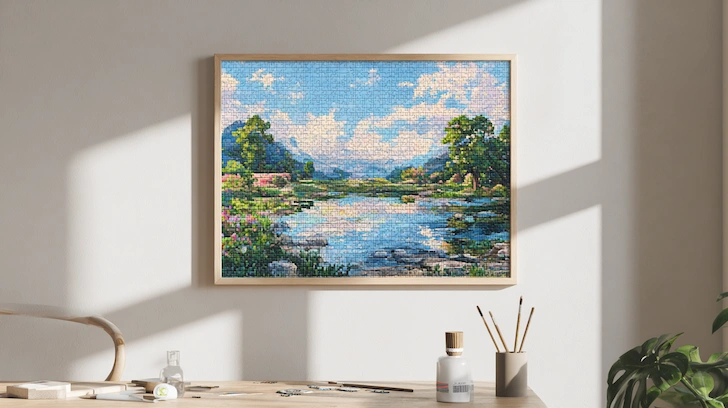
How to Frame a Puzzle: Proven Methods for a Flawless Display
The Puzzle Preservation Playbook
Preserving your finished jigsaw puzzle is a straightforward process that you can master on your first try. The most common mistake is not measuring the puzzle yourself before buying a frame, so always use your own measurements, not the dimensions on the box. Your biggest decision will be choosing between traditional glue and modern, mess-free adhesive sheets.
To ensure your puzzle looks great for years to come, follow these core principles:
- Always measure it yourself. The dimensions printed on the puzzle box are often inaccurate. Measure your finished work to get the exact height and width before you even think about buying a frame.
- Choose your adhesive wisely. You can use traditional puzzle glue for a permanent, solid bond, but a cleaner alternative is using peel-and-stick adhesive sheets on the back, which preserves the puzzle's original front surface.
- Use a rigid backing. The secret to a professional, long-lasting display is mounting your puzzle onto a piece of foam board. This simple step prevents the puzzle from sagging or warping inside the frame over time.
Framing is one of the most rewarding ways to preserve your work, turning a temporary hobby into a permanent piece of art. If you're looking for other ideas, there are many creative things to do with completed jigsaw puzzles.
Why Turn Your Puzzle into a Permanent Masterpiece?
Framing your puzzle protects your hard work from damage and transforms it into a unique piece of art that adds a personal touch to your home. It’s a way to commemorate the time and focus you invested in completing it.
A frame with a glass or acrylic cover is the best defense against dust, moisture, and accidental bumps, ensuring your puzzle stays in perfect condition. The final result is a beautiful display piece that celebrates your accomplishment.
The quality of the puzzle itself can also affect the final look, as some brands are known for creating truly frame-worthy jigsaw puzzles with high-quality images and materials. Be sure to budget for the full project, which typically includes the puzzle itself ($15-$25), adhesive ($6), and a suitable frame ($30-$50).
Choosing Your Method: Glue vs. Glue-Free Preservation
Your main choice is between traditional puzzle glue, which creates a solid piece from the front, and mess-free adhesive sheets that stick to the back. Both methods are effective, so you can choose the one that best fits your comfort level.
The Traditional Glue Method This classic approach involves applying a special puzzle glue or a clear-drying craft glue like Mod Podge directly onto the front of your puzzle. This seeps into the cracks between the pieces, bonding them together into a single, solid unit.
To do this correctly, pour a small amount of glue onto the puzzle's surface. Use a flat-edged tool, like a plastic scraper or a stiff piece of cardboard, to spread a thin, even layer across the entire image. Avoid using a paintbrush, which can leave behind visible streaks.
The Modern Adhesive Sheet Method For a completely mess-free alternative, you can use large peel-and-stick adhesive sheets. These are applied to the back of the puzzle, which means the original look and texture of the front surface remain completely untouched.
To apply them, you'll first need to flip your puzzle over. The safest way to do this is to sandwich the puzzle between two large, rigid pieces of cardboard, hold them together firmly, and then flip the entire "sandwich." Once it's face-down, you can apply the adhesive sheets to the back.
While adhesive sheets are the most popular glue-free option, there are other puzzle glue alternatives like using painter's tape on the back, though these are generally considered less permanent solutions.
The F.L.A.T. Method: Your 4-Step Framing Plan
Follow the four-step F.L.A.T. method—Flatten, Lock, Attach, and Transfer—to ensure a perfect, professional-looking result every time. This system breaks the process down into simple, manageable actions.
1. Flatten & Measure
- Place your finished puzzle on a clean, flat work surface.
- Use a rolling pin to gently press the entire puzzle, ensuring every piece is fully interlocked and the surface is as flat as possible.
- Measure the exact height and width yourself. Do not trust the dimensions on the box.
2. Lock the Pieces
- Choose your preferred method—glue or adhesive sheets—and apply it according to the instructions.
- If you use glue, let it dry to the touch (about 20 minutes) and then allow it to fully cure for 12-24 hours before moving on.
- To prevent the puzzle from curling as the glue dries, you can optionally apply a second coat to the back after the front is completely dry.
3. Attach to Backing
- To prevent your puzzle from sagging over time, mount it onto a rigid backing. Foam board or a self-adhesive mounting board are the best choices for this.
- Use spray adhesive or the board's built-in adhesive to secure the back of your puzzle to the backing board.
4. Transfer to Frame
- Select a frame that is deep enough to hold your puzzle. Most standard cardboard puzzles are less than 1/8" thick, but once mounted on foam board, they require more depth than a standard picture frame allows.
- Choose a protective cover. UV-filtering acrylic is often a better choice than glass because it's lighter, shatter-resistant, and less likely to trap moisture.
- Place your mounted puzzle into the frame, secure it, and get ready to hang your new artwork.
While this guide focuses on framing, there are other creative options if you decide a frame isn't the right fit. You can explore different ways for how to hang a puzzle without a frame to find the perfect display for your space.
Common Framing Pitfalls (And How to Avoid Them)
You can easily avoid common issues like lifting pieces, surface streaks, or a sagging puzzle by using enough glue, the right tools, and a rigid backing board. Here are the solutions to the most frequent problems.
- Problem: The puzzle pieces are lifting or separating. This usually means you didn't use enough glue to fully penetrate the cracks. Apply a second thin coat, focusing on sealing the gaps between the pieces.
- Problem: The puzzle surface has visible streaks or brush marks. This is almost always caused by using a paintbrush. Always apply glue with a flat-edged scraper or squeegee to get a smooth, even finish.
- Problem: The puzzle is sagging or bowing inside the frame. This happens when the puzzle isn't supported. To fix it, carefully remove the puzzle from the frame and mount it onto a piece of foam board for stability.
- Problem: The frame is too shallow to close properly. You've likely chosen a standard picture frame. You need a deeper frame specifically designed to accommodate the thickness of a puzzle and its backing.
If you decide not to frame your puzzle after all, it's worth considering proper disposal. Depending on the material, you may be wondering, can you recycle jigsaw puzzles?
From Hobby to Home Decor: Displaying Your Framed Puzzle
Once framed, hang your puzzle securely using a level and appropriate hardware to transform your hobby into beautiful, personal home decor. Make sure to use hangers, like D-rings, that can support the weight of the frame.
For a bigger impact, consider creating a gallery wall of your favorite framed puzzles. You can also display them seasonally, swapping them out to keep your decor fresh. Some deeper frames are even designed to hold two mounted puzzles at once, making storage and rotation simple.
If the process feels too intimidating, professional framing services can handle everything for you. They can ensure a perfect result for your most prized puzzles, though they often have size limitations; one major service, for example, has a maximum size of 32"x40".
Frequently Asked Questions
Why is it important to measure my puzzle before buying a frame?
You must measure your finished puzzle yourself because the dimensions printed on the box are often inaccurate. Using your own measurements for height and width is the only way to guarantee you purchase a frame that fits perfectly.
What's the difference between using puzzle glue and adhesive sheets?
Puzzle glue is applied to the front, seeping into the cracks to create a single, solid piece, often with a glossy finish. Adhesive sheets are a mess-free alternative applied to the back, which holds the pieces together while preserving the puzzle's original surface texture.
Why do I need to mount my puzzle on a backing board?
Mounting your puzzle on a rigid backing, like foam board, is crucial for preventing it from sagging or warping inside the frame over time. This step provides the structural support needed for a professional and durable display.
What is the easiest way to frame a puzzle?
The simplest method is to frame the puzzle right to its edges without using a decorative mat. After securing the pieces with glue or adhesive sheets, you just need a frame that matches your puzzle's exact dimensions and is deep enough to hold it.
Can I frame a puzzle without gluing it?
Yes, you can easily frame a puzzle without glue by using large peel-and-stick adhesive sheets. These are applied to the back of the puzzle to hold all the pieces together, offering a clean, mess-free alternative to traditional liquid glues.
Should I glue both sides of a puzzle?
Gluing the front is usually sufficient for most projects. However, applying a second coat to the back after the front is completely dry can provide extra stability and help counteract any curling that occurs as the front glue dries.
How do I measure a puzzle that isn't a perfect rectangle?
For puzzles with irregular or non-rectangular shapes, measure the widest horizontal point to determine the width and the tallest vertical point for the height. These maximum dimensions will dictate the size of the frame and backing you need.
Do wooden puzzles require a special type of frame?
Yes, because wooden puzzles are significantly thicker than standard cardboard ones, they require a deeper frame. You should look for shadow box frames or custom frames specifically designed to accommodate the extra depth of the puzzle and its backing.
What are some common frame sizes for 500 and 1000-piece puzzles?
While you must always measure your specific puzzle, common sizes for 500-piece puzzles are often around 18"x24". For 1000-piece puzzles, a frequent size is approximately 20"x30", but variations between brands are common.