
JSPuzzles is now on iPhone, iPad and Android
Free. The daily puzzle and thousands of puzzles, on your phone or tablet.


 Scan to get the app
Free. The daily puzzle and thousands of puzzles, on your phone or tablet.
Scan to get the app 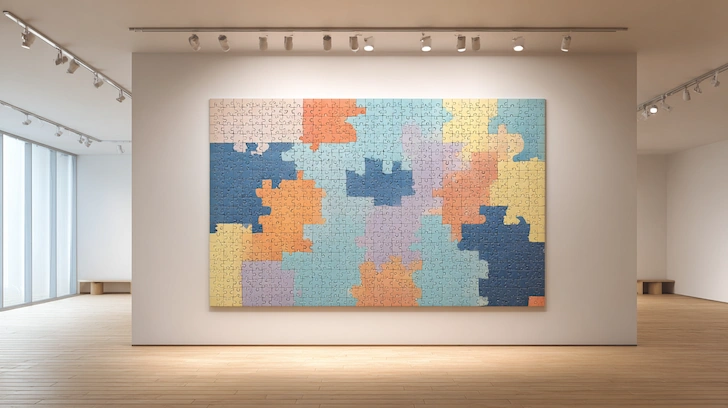
You can achieve a durable, professional-looking display for your puzzle without a frame using common materials like Mod Podge, duct tape, and Command Strips. The process is simple: you seal the front, reinforce the back, and then hang it on your wall. This guide walks you through every step.
This is just one of many creative options for turning your hard work into a piece of art, and it's a great starting point if you're wondering what to do with your finished jigsaw puzzles. For those who want to avoid liquid glue entirely, mess-free alternatives like peel-and-stick adhesive sheets offer an even quicker solution.
Choosing to hang a puzzle without a frame gives you complete creative control and is the most cost-effective way to display your work. This method creates a unique, minimalist look that puts all the focus on the puzzle's artwork.
By skipping the often high cost of custom framing, you can easily turn your completed jigsaw puzzles into lasting home decor. This approach offers several key advantages:
To successfully mount your puzzle, you will need a few key supplies for sealing the surface, reinforcing the back, and hanging the final piece. Most of these are common craft materials that are both inexpensive and easy to find.
Your primary tool for sealing the puzzle is a water-based sealer like Mod Podge, which dries clear and protects the image. A single bottle is very affordable and can be used to seal dozens of puzzles, making it a great investment for this hobby. While there are specialized puzzle glues, you can learn more about the differences and decide if you need them by exploring puzzle glue versus Mod Podge.
Here is a simple breakdown of what you'll need:
For Sealing the Surface:
For Reinforcing the Back:
For Hanging the Puzzle:
This simple three-step framework will guide you from a finished puzzle on your table to a secure piece of art on your wall. Follow these actions in order to ensure a durable, long-lasting display.
Seal the Surface
Strengthen the Structure
Mount the Masterpiece
The best way to hang your puzzle depends on your wall type and how permanent you want the display to be. Here are the three most effective methods, from temporary and damage-free to permanent and ultra-secure.
1. Damage-Free Strips (The Renter's Choice) This is the ideal method for anyone who wants to avoid damaging their walls. Command Strips and other similar adhesive picture-hanging products are designed to hold strong but remove cleanly. For extra security in humid rooms, you can add a small ball of mounting putty to the corners, but never rely on putty alone.
2. Backer Boards (The Rigidity Solution) To prevent any chance of your puzzle warping over time, you can mount it to a rigid backer board. Use a spray adhesive to attach your sealed puzzle to a thin board, which provides a perfectly flat and durable foundation.
3. Direct Mounting (The Permanent Display) For a more permanent installation, you can attach the puzzle directly to the wall. This can be done with thumbtacks (for drywall), binder clips hung on small nails, or by screwing a puzzle on a backer board directly into the wall. To hide the screws, simply remove a few puzzle pieces, drive the screws through the backer, and then glue the pieces back into place over the screw heads.
Creating a beautiful frameless display is straightforward, but a few common mistakes can cause problems. By keeping these points in mind, you can ensure your project is a success from start to finish.
Hanging your puzzle on the wall is just one of many ways to display it. Once your puzzle is sealed and reinforced, you can get creative and integrate it into your home decor in other unique ways.
The simplest method is to seal the front with a clear glue like Mod Podge, reinforce the back with duct tape or adhesive sheets, and then mount it to the wall using Command Picture Hanging Strips. This creates a durable, minimalist display without the cost of a frame.
The most cost-effective method is to use common household materials. Sealing the front with Mod Podge and reinforcing the entire back with overlapping strips of duct tape provides a strong, long-lasting hold for just a few dollars.
Besides mounting it directly on the wall, you can attach your sealed puzzle to a foam core board or canvas for added rigidity. Other creative options include displaying it on an easel, inside a shadow box, or under the glass top of a coffee table.
You will need a sealer like Mod Podge for the front, duct tape or peel-and-stick adhesive sheets for the back, and Command Strips or mounting putty for hanging. It's also wise to have wax paper to protect your work surface.
When properly sealed on the front and reinforced with a full grid of duct tape on the back, a puzzle can hang securely for several years. The key is to ensure complete coverage on the back to prevent warping and maintain structural integrity over time.
Peel-and-stick sheets are not necessarily better, but they are a faster and completely mess-free alternative to liquid glue. While they are very effective, they are typically more expensive than a bottle of Mod Podge, which can be used to seal dozens of puzzles.
While Mod Podge offers a gloss finish, for a truly thick, high-gloss, and glass-like coating, you can use a two-part epoxy resin. This creates a very durable and professional-looking finish but is a more advanced technique that requires careful mixing and application.
For a durable, long-lasting display, you must do both. Sealing the front with Mod Podge protects the image and bonds the pieces, while reinforcing the back with tape or more glue provides the structural integrity needed to hang it on a wall.

 Scan to get the app


